
Custom Sand Casting for Industrial Components
LANJIAN manufactures custom sand castings for machine bases, equipment housings, structural supports and other industrial machinery components based on customer drawings.
Before production, we review the material, casting geometry, pattern and core requirements, machining allowances and inspection criteria. The approved route is then followed through molding, pouring, cooling, shakeout, cleaning and as-cast inspection.
- Drawing-Based Custom Production
- Pattern, Mold and Core Planning
- Sand Casting Process Control
- Casting-Specific Quality Inspection
Scope: Custom sand-cast industrial components—not standard stock parts or complete machines.

What Is Sand Casting?
Sand casting is an expendable-mold metal casting process in which molten metal is poured into a cavity formed in compacted sand. Once the metal has cooled and solidified, the sand mold is broken away to remove the casting. Separate sand cores may be positioned inside the mold to form holes, passages and other internal cavities.
A pattern is used to form the external shape of the mold cavity and is removed before pouring. Because metal contracts during cooling and some surfaces require subsequent machining, the pattern and casting process design may include shrinkage allowance, draft angles, fillets, core prints and machining allowance.
Common industrial molding systems include moisture-containing, clay-bonded green sand and chemically bonded systems such as resin-bonded no-bake sand. The appropriate system is selected according to the casting size, geometry, alloy, production quantity and required dimensional control.
When Is Sand Casting the Right Choice?
Sand casting is commonly selected for industrial components that require one or more of the following:
- Medium, large or heavy casting sizes
- Complex external shapes or cored internal cavities
- Flexible production from prototypes to repeat orders
- Gray iron, ductile iron, carbon steel, alloy steel or stainless steel
- A lower tooling investment than many permanent-mold casting processes
Typical applications include machine bases, equipment housings, bearing supports, pump and valve bodies, brackets and structural castings.
Sand casting does not normally provide final machined accuracy on mating surfaces, bearing bores, threads or other tight-tolerance features. These areas are typically produced with machining allowance and finished after casting. Final process suitability therefore depends on the component geometry, material, section thickness, quantity, dimensional requirements and inspection criteria.
Verified Sand Casting Capability
LANJIAN produces custom sand castings from 5 to 2,000 kg, with overall dimensions up to 2,000 × 1,500 × 1,000 mm. Green sand or resin-bonded no-bake molding is selected according to the casting geometry, alloy, production quantity and dimensional requirements.
Capability | Available Range or Options | |
Casting Weight Range | 5–2,000 kg per casting | |
Maximum Casting Dimensions | Up to 2,000 × 1,500 × 1,000 mm | |
Sand Molding Systems | Resin-bonded no-bake sand molding; manual or machine green sand molding | |
Pattern and Core Options | Wood, resin/polyurethane, aluminum and 3D-printed polymer patterns; no-bake resin sand and cold-box cores | |
As-Cast Tolerance | ISO 8062-3, typically CT10–CT12; the final tolerance class depends on the molding route, casting size and geometry. Critical features can be finish-machined. | |
As-Cast Surface Finish | Typically Ra 12.5–50 μm, depending on the molding system, alloy, casting size and surface location | |
Material Options | Gray iron, ductile iron, carbon steel, alloy steel and stainless steel; material grades can be supplied to applicable ASTM, EN, DIN, GB or customer-specified standards | |
Inspection and NDT | Chemical composition, hardness, mechanical properties, metallography, visual and dimensional inspection; MT, PT, UT, RT and independent third-party inspection can be arranged as required |
Capability Confirmed Against Your Drawing
The ranges above define our general sand casting capability. Final feasibility is confirmed after reviewing the material grade, casting geometry, section thickness, core design, tolerances and inspection requirements.
For castings outside the listed range or with special acceptance requirements, submit your drawing for an individual manufacturing review.
How Does Our Sand Casting Process Work?
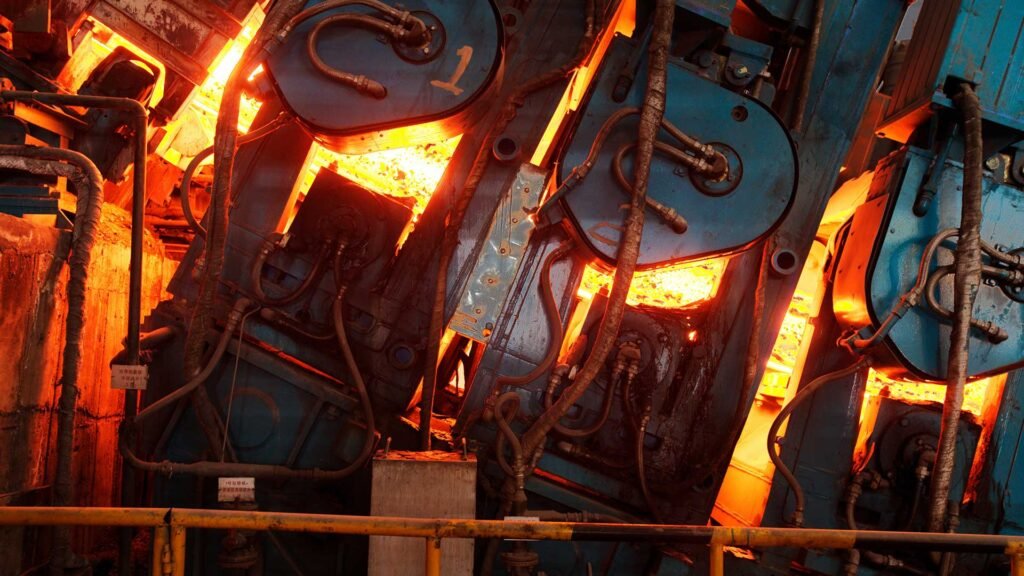
Our sand casting process follows eight stages: process design, tooling preparation, mold and core making, mold assembly, melting and pouring, cooling and shakeout, post-casting processing, and final inspection.
The exact production route is adjusted according to the casting alloy, geometry, size and required delivery condition.
01 — Process Design
We confirm the casting orientation, parting line, shrinkage and machining allowances, core requirements, and gating and feeding plan from the approved drawing.
02 — Tooling Preparation
Patterns and core boxes are prepared and checked for key dimensions, locating features, core prints and specified allowances.
03 — Mold and Core Making
Green sand is compacted or resin-bonded no-bake sand is cured around the pattern. The pattern is removed to form the mold cavity, and separate sand cores are produced where required.
04 — Mold Assembly
Cores are positioned, the mold is closed, and the cavity, gating, risers and vents are checked before pouring.
05 — Charge Preparation, Melting and Pouring
Charge materials are proportioned according to the specified material grade. After melting, the chemical composition and temperature are checked and adjusted before the metal is poured into the prepared mold.
06 — Cooling and Shakeout
The casting cools and solidifies inside the mold before the sand is broken away and the casting is removed.
07 — Cleaning and Post-Processing
Residual sand, gates, runners, risers and flash are removed. Shot blasting, heat treatment, machining or surface protection follows when required.
08 — Inspection and Release
Applicable material verification, visual and dimensional inspection, and specified NDT are completed before the casting is documented, protected and packed.
Separate sand cores, heat treatment, machining and NDT are applied only when required by the drawing and acceptance criteria.
How Is Sand Casting Quality Controlled?
Sand casting quality is controlled before, during and after pouring by defining the acceptance requirements, controlling molding sand and metal composition, checking molds and cores, monitoring pouring conditions, and inspecting the finished casting for surface integrity, dimensions, material properties and internal soundness.
The inspection method, sampling scope, acceptance level and required reports are confirmed according to the approved drawing and project specifications.
01 — Quality Requirements
Material grade, critical dimensions, casting tolerance, surface condition, NDT requirements and inspection documents are confirmed before production.
02 — Molding Sand Control
Base sand, binder, water and additives are proportioned for the selected molding system. Green sand properties and no-bake sand mixing and curing conditions are monitored.
03 — Pattern, Mold and Core Checks
Tooling condition, key dimensions, mold cavity, core position, coatings, gating, risers and vents are checked before the mold is closed.
04 — Charge and Melt Control
Charge materials are proportioned for the specified grade. Chemical composition, melt treatment and pouring temperature are checked and adjusted before pouring.
05 — Pouring and Traceability
Ladle condition, pouring temperature and pouring time are controlled. Heat, mold and casting identification are maintained according to the traceability requirements.
06 — Surface and Dimensional Inspection
After cleaning, castings are checked for cracks, incomplete filling, sand inclusions and excess metal. Critical dimensions are verified against the approved drawing.
07 — Material Testing and NDT
Hardness, tensile or impact testing, metallography, MT, PT, UT or RT are performed when required by the material standard, drawing or inspection plan.
08 — Final Review and Release
Inspection results and required reports are reviewed against the agreed acceptance criteria. Third-party inspection can be coordinated before the casting is released for shipment.
Visual and dimensional checks are included in the release plan. Mechanical testing, metallography, NDT and third-party inspection are applied according to the specified inspection scope.
Questions Buyers Ask About Sand Casting
These answers address the practical questions engineers and buyers commonly need to resolve when evaluating a custom sand casting, including process selection, materials, tooling, cores, tolerances, defect control, finished delivery, cost and lead time.
Sand casting is commonly selected for medium, large or heavy components, complex external shapes, and parts requiring cored internal cavities. It can support prototypes, replacement parts and repeat production across a wide range of casting sizes.
Components requiring extremely thin walls, fine as-cast surfaces or tight tolerances may need another casting process or additional machining. Final suitability should be confirmed from the drawing, material and quantity.
Green sand uses moisture-containing, clay-bonded sand and is generally suitable for small-to-medium castings and repeat production where molding speed and cost efficiency are important.
Resin-bonded no-bake sand hardens through a chemical binder system and is often selected for larger, heavier or more complex castings requiring a stronger mold and better dimensional stability. The appropriate system depends on part size, alloy, geometry, quantity and tolerance requirements.
Sand casting can process many ferrous and non-ferrous alloys. LANJIAN focuses on gray iron, ductile iron, carbon steel, alloy steel and stainless steel sand castings.
The exact material grade, applicable standard, heat treatment and required mechanical properties must be confirmed before production. Similar material descriptions should not be treated as equivalent grades without technical review.
Yes. Separate sand cores can be positioned inside the mold to form holes, passages and internal cavities that cannot be created by the external pattern alone.
Core feasibility depends on the internal geometry, core support, passage size, venting and access for removing residual sand. Long, narrow or highly complex cavities may require a multi-piece or specialized core design.
Yes. Sand casting is often economical for prototypes, replacement components and low-volume orders because pattern tooling generally costs less than permanent-mold or die-casting tooling.
Wood, resin or 3D-printed polymer patterns may be considered for lower quantities, while aluminum tooling is normally more durable for repeat production. Tooling selection depends on casting size, complexity, required accuracy and expected production life.
As a general reference, sand castings are typically produced to ISO 8062-3 tolerance grades around CT10–CT12, with as-cast surface finishes of approximately Ra 12.5–50 μm.
Actual results depend on the molding system, alloy, casting size, parting line, core position and surface location. Bearing bores, mounting faces, threads and other critical features are normally finish-machined.
Wall thickness transitions, sharp corners, draft angles, parting-line location, core design and machining allowance can all affect mold filling, solidification, dimensional stability and cleaning.
More uniform wall sections, suitable fillets and radii, adequate draft and clearly identified machining surfaces generally improve castability and reduce defect and machining risks.
Typical risks include shrinkage, porosity, sand inclusions, incomplete filling, cracking, core shift and dimensional variation.
These risks are controlled through casting design, gating and riser arrangement, molding sand properties, metal chemistry, pouring temperature and cooling conditions. Visual, dimensional and specified NDT methods are used to verify the finished casting.
Yes. Depending on the project, sand castings can be delivered as casting blanks, rough-machined parts, finish-machined components, surface-protected parts or assembly-ready components.
Heat treatment, hardness or mechanical testing, metallography, MT, PT, UT, RT and third-party inspection can be arranged when specified. The method, extent, acceptance standard and required reports are confirmed before production.
The main factors are pattern and core-box complexity, alloy, casting weight, metal yield, number of cores, order quantity, heat treatment, machining and inspection requirements. Existing suitable tooling may reduce preparation time, while new or modified patterns require additional engineering and manufacturing time.
For an accurate quotation, provide the 2D drawing or 3D model, material grade, quantity, required delivery condition, critical dimensions, machining scope and inspection requirements.
Ready to Turn Your Drawing Into a Reliable Sand Casting?
Send your drawing, 3D model or available casting requirements. LANJIAN will review the material, molding route, pattern and core requirements, machining scope, inspection requirements and delivery condition before quotation.
- Green Sand or No-Bake Molding Route Reviewed
- Pattern, Core and Casting Risks Considered
- Heat Treatment, Machining and NDT Coordinated as Required
- Quotation Based on a Confirmed Manufacturing Scope
Privacy note:
Your drawings and project information are kept confidential and used only for technical review, quotation and order execution.
Prefer Email?
Start Your Sand Casting Project
Send what you have. We’ll review your casting requirements and identify what still needs to be confirmed before quotation.